
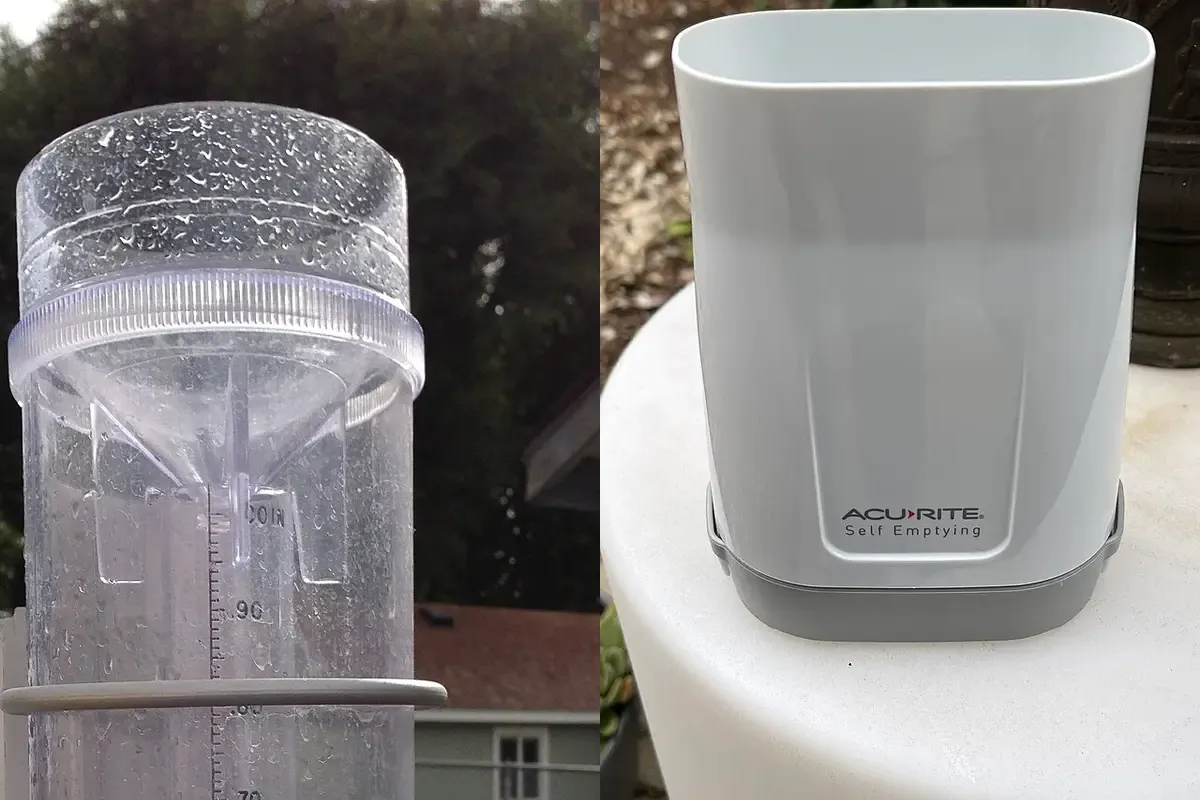

A manual rain gauge is a marked tube you read with your own eyes; a digital rain gauge measures the rain itself and sends the figure to a screen or phone. For most Australian farms and homes, a good manual gauge read at 9am is still the most reliable choice, and a digital gauge earns its place when you're often away or want to know how hard it rained, not just how much.
How A Manual Rain Gauge Works
A manual gauge is a funnel sitting on a clear, marked tube. Rain falls into the funnel, runs into the tube, and you read the level against the scale. The Bureau of Meteorology's own standard gauge works the same way: a 203 mm funnel feeding a measuring cylinder that holds up to 25 mm, mounted with the top 0.3 m above the ground, and read as close to 9am as possible. If a storm fills it, the observer empties it and adds the amount to the next 9am reading.
The plastic gauges sold at hardware stores are simpler versions of the same idea. Read the bottom of the curved water surface at eye level, write it down, and empty the gauge. Our guide on how to read a rain gauge covers it step by step.
How A Digital Rain Gauge Works
Most digital gauges use a tipping bucket. Under the funnel sits a tiny see-saw with a cup on each end. When one cup fills with a set amount of water, often around 0.2 mm of rain, it tips, empties, and the other cup moves into place. Each tip is counted electronically, so the gauge knows how much fell and when. A wireless sensor sends the count to a display inside, or to an app on your phone.
Because it counts as the rain falls, a digital gauge can tell you when the rain started and stopped, and how heavy it was at its peak. Automatic weather stations, including many the Bureau runs, use tipping-bucket gauges for exactly that reason.
Accuracy, Cost And Upkeep Compared
| Manual rain gauge | Digital rain gauge | |
|---|---|---|
| Accuracy | Very good if read carefully at eye level | Good, but can under-read in very heavy rain when the bucket can't tip fast enough |
| What it tells you | The total since you last emptied it | Totals, timing and how heavy the rain was |
| Cost | Inexpensive | Costs more, and usually needs a display or app |
| Power | None | Batteries in the sensor and display |
| Upkeep | Rinse, check it's level and not cracked | Clear leaves, insects and spiders from the funnel and bucket; change batteries; check it against a manual gauge |
| If you're away | It keeps collecting, but can overflow | It keeps counting, as long as the batteries and signal hold |
Both need the same good spot: firm, level, open ground, clear of trees, walls and sheds. A blocked funnel ruins either one, so check it after storms. Many people who buy a digital gauge keep a manual one beside it as a check. If the two disagree by more than a millimetre or so, the funnel or the bucket probably needs a clean.
Which Rain Gauge Is Right For You?
- Choose a manual rain gauge if you're home most mornings, want the most trustworthy daily figure, and don't want to think about batteries. It's what most rain books and long records are built on.
- Choose a digital rain gauge if you're often away, look after several properties, or want to see when the rain fell and how heavy it was.
- Use both if your records matter for the bank, drought support or long-term planning. The manual gauge is your official 9am figure; the digital one fills in the detail.
Whichever you choose, the reading is only useful once it's written down. The free GaugeMate rain gauge app takes your 9am reading in a couple of taps, in millimetres, points or inches, lets you add a note such as "storm" or "gauge overflowed", and spreads rain over several days when you've been away. If you're weighing up apps too, see what to look for in a rainfall app.
Is Rain Measured In mm Per Hour?
Two different things are being measured. How much rain fell is measured in millimetres: 25 mm means the rain would stand 25 mm deep on flat ground. That's what your gauge shows, and what goes in the rain book. How hard it rained is measured in millimetres per hour (mm/h), and that's what a digital gauge or weather radar can work out.
The same 25 mm can arrive very differently. Spread over a whole day it's about 1 mm an hour, a soaking rain that mostly goes into the ground. Dumped in half an hour by a storm, it's 50 mm an hour, and much of it runs off. As a rough guide, the international definitions the Bureau is adopting for its weather observations call rain under 2.5 mm an hour light, 2.5 to 10 mm an hour moderate, and over 10 mm an hour heavy.
So a manual gauge gives you the total, and that's what matters for most farm records. If you want the rate as well, that's where a digital gauge comes in. Old records in points? Our rain converter and guide to points of rain to mm will bring them up to date.