
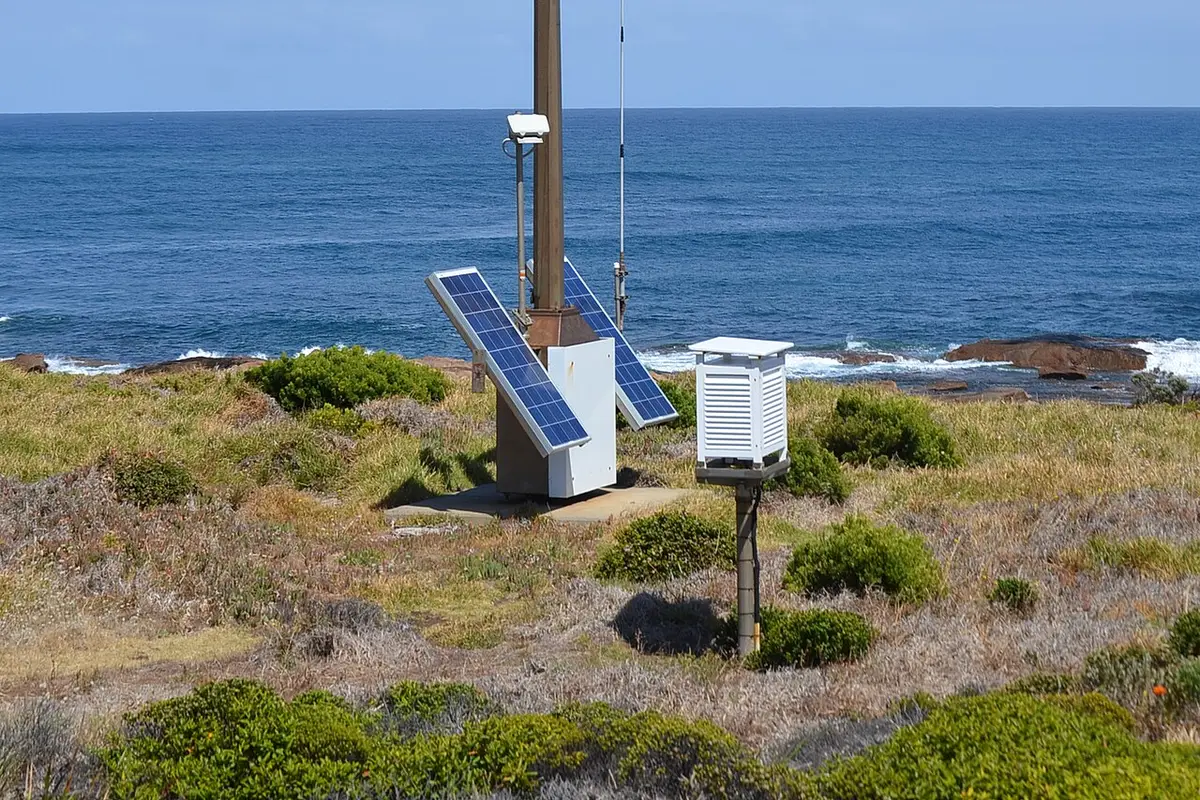

A weather station with a rain gauge is worth it if you want more than the daily rain total: wind, temperature, humidity and when the rain fell, all logged for you. If rain is the only number you care about, a good manual gauge read at 9am is cheaper, simpler and usually more accurate.
Here's what a home weather station actually gives you, where its rain gauge falls short, and how to decide.
What A Home Weather Station Measures
Most home weather stations have an outdoor sensor unit and an indoor display, a phone app, or both. The popular "all-in-one" or "7-in-1" sensors put everything on one pole:
- Rain, using a small tipping-bucket gauge that counts the rain as it falls (the same idea as a stand-alone wireless or digital rain gauge)
- Wind speed and direction
- Temperature and humidity
- Air pressure, usually measured by the indoor display
- UV and sunlight, on many models
The real advantage is the record. A station logs readings every few minutes, so you can see when a storm hit, how hard it rained, how strong the wind gusted, and how cold it got overnight. For spraying, frost watch or checking on a property you're not at, that detail is genuinely useful.
How Accurate Is A Weather Station Rain Gauge?
The rain gauge is usually the weakest part of a home weather station, for three reasons:
- Where it sits. Wind is best measured high up: official wind readings are taken 10 m above the ground. Rain is best measured low down: the Bureau of Meteorology's standard gauges sit with their top just 0.3 m above the ground. An all-in-one sensor can't do both. Mounted high on a pole or a roof, its rain gauge catches gusty, swirling air and usually collects less than a gauge near the ground.
- Size. The collecting funnel on many all-in-one sensors is small, so a few leaves, a spider web or a bird dropping can block it.
- Heavy rain. Like other tipping-bucket gauges, it can under-read in a downpour, when the bucket can't tip fast enough.
None of this makes a weather station useless for rain. It just means its figure is best treated as a guide and a timeline, not your official total. Plenty of people who own one still keep a manual gauge as their record and use it to check the station now and then. If the two disagree by more than a millimetre or so, clean the funnel and check the station is level.
What You'll Pay And What You Get
Prices change often, but as a rough guide from Australian retailers in November 2026:
| Type | Typical price | What you get |
|---|---|---|
| Wireless rain gauge with indoor display | Under $50 | Rain, often with temperature |
| Popular all-in-one weather station | About $150 to $300 | Rain, wind, temperature, humidity, pressure; often an app |
| Premium weather station | $400 and up | Better sensors, longer range, sturdier build |
| Manual rain gauge | A small fraction of any of these | Rain only, read by eye |
Running costs are small but real. Expect batteries in the outdoor sensor, a regular clean of the rain funnel, and occasionally a replacement part after a few years in the sun. Check the wireless range against the distance from your house to where the sensor will go, and whether the app keeps your data if the company changes its service.
Who Should Buy A Weather Station With A Rain Gauge?
It's a good buy if you:
- want wind, temperature and humidity as well as rain, for spraying, frost or fire weather
- are often away and want to see what happened while you were gone
- enjoy weather watching and like the charts
You can probably skip it if you:
- only need a reliable daily rain total for your records
- want the simplest, cheapest option with nothing to charge or replace
- need figures that line up with a long run of manual readings or the Bureau's 9am totals
Many farms end up with both: a manual gauge for the official 9am figure, and a weather station for everything else.
Keeping Your Rain Records In One Place
Whichever gauge you trust, the reading only counts once it's written down. The free GaugeMate rain gauge app takes your 9am reading in a couple of taps, keeps several gauges and properties in one place, and lets you add notes such as "storm" or "gauge overflowed". It's useful for spotting when the weather station and the manual gauge disagree, too. New to reading a gauge? Start with how to read a rain gauge, and if you're comparing apps, see what to look for in a rainfall app.